
NovaStar MX6000 Pro 8K LED Display Controller | COEX
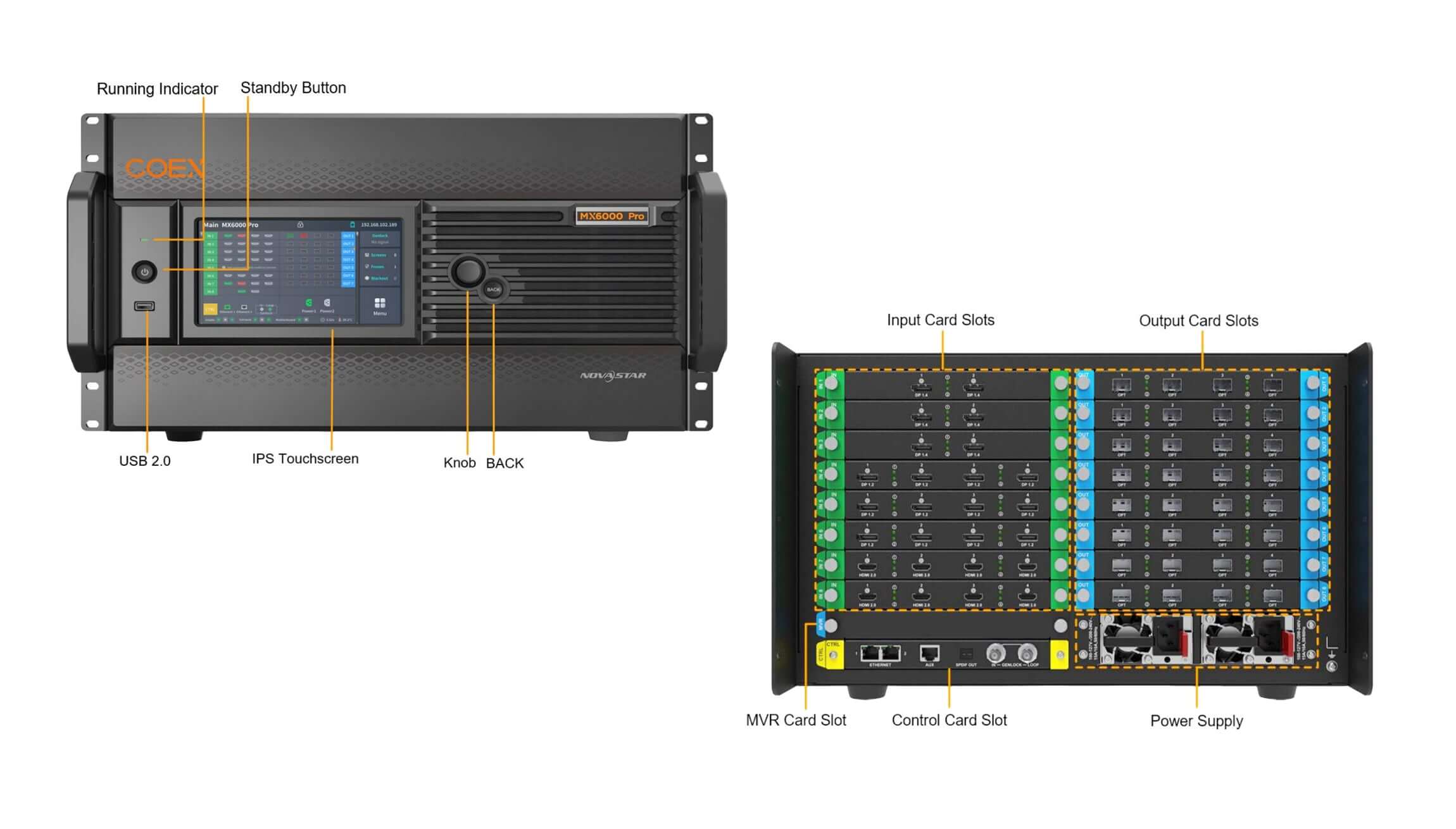
The NovaStar MX6000 Pro is a modular 6U COEX LED display controller with eight input-card slots and eight output-card slots. Configure a 1G or 5G output system to suit the receiving cards and fiber converters. VMP provides screen configuration and monitoring.
Contact sales for specific pricing and the required card configuration.
NovaStar MX6000 Pro modular 8K LED controller
The MX6000 Pro is a COEX-series LED display controller for large event screens, fixed installations and virtual-production stages. Its card-based design lets a project select the video interfaces and fiber output architecture it needs. The chassis supports up to 32 × 4K or 8 × 8K video inputs and a manufacturer-stated maximum load of 141 million pixels; the installed cards, signal format and screen configuration determine the usable system capacity.
Select the input and output cards
Eight input slots accept the card types listed below. An input-card option is not a statement that the card is included in the quoted chassis. Confirm the required cards and source formats when requesting pricing.
| Parameter | Specification |
|---|---|
| MX_4xHDMI 2.0 | 4 HDMI 2.0 inputs; up to 4096 × 2160 @ 60 Hz at 8-bit. At 10/12-bit, maximum rate depends on chroma sampling. |
| MX_4xDP 1.2 | 4 DP 1.2 inputs; up to 4096 × 2160 @ 60 Hz at 8/10-bit. At 12-bit RGB/YCbCr 4:4:4, the listed maximum is 4096 × 2160 @ 50 Hz. |
| MX_4x12G-SDI | 4 SDI inputs; up to 4096 × 2160 @ 60 Hz, 10-bit YCbCr 4:2:2; interlaced-to-progressive conversion supported |
| MX_2xHDMI 2.1 | 2 HDMI 2.1 inputs; maximum forced format 8192 × 4320 @ 30 Hz, with 8/10/12-bit input support |
| MX_2xDP 1.4 | 2 DP 1.4 inputs; up to 7680 × 4320 @ 30 Hz at 8-bit. Higher bit-depth limits depend on sampling format; see the video-source table in the PDF. |
| Video over IP | 1 × SMPTE ST 2110 (25G) card option |
Input-card documentation note: The earlier listing mentioned an NDI card. The linked V1.1.1 specification confirms six input-card types and lists SMPTE ST 2110 for Video over IP; it does not confirm NDI. Confirm an exact supported NDI configuration before ordering for that requirement.
For a 1G system, use MX_4x10G_Fiber output cards with CVT10 or CVT10 Pro converters and compatible Armor-series receiving cards. For a 5G system, the documented solution uses CX_1x40G_Fiber output cards, CVT8-5G converters and compatible 5G receiving cards such as CA50E, CA50C or XA50. V1.1.1 states that 1G and 5G solutions cannot be built simultaneously in one MX6000 Pro.
Screen composition, color and monitoring
- Configure screens by output card and move layers across cards within a screen.
- Use up to four layers per output card or up to 32 × 4K layers across the device, with custom, pixel-to-pixel, snap-to-canvas and fill-screen scaling.
- Save up to 128 presets containing settings such as layers, brightness, color temperature and gamma.
- Adjust color with 14-channel correction, RGBW curves and 17 × 17 × 17 .cube 3D LUT files.
- Support HDR10 and HLG. DP 1.2, 12G-SDI and non-standard HDR sources require manual HDR-property settings.
- Use VMP and the 7-inch touchscreen for control, with real-time input/display monitoring and hardware fault alarms.
- Support device, output-card and Ethernet-port hot backup, plus dual-power-supply backup.
MX6000 Pro specifications
| Parameter | Specification |
|---|---|
| Chassis | 6U; 8 input-card slots and 8 output-card slots |
| Video input bit depth | 8-bit, 10-bit and 12-bit; available resolutions depend on the input card and sampling format |
| Maximum stated load | 141 million pixels; confirm the actual card, bit-depth, frame-rate and screen configuration |
| Frame-rate capability | Up to 360 Hz, subject to the screen hardware configuration |
| 1G output card | 4 × 10G optical ports; each represents 10 × 1G Ethernet ports, up to 40 Ethernet outputs per card |
| 5G output architecture | 1 × 40G optical port per card, serving up to 8 × 5G Ethernet ports through the compatible converter |
| 1G Ethernet load example | 659,722 pixels per port at 8-bit / 60 Hz, as listed in the detailed load table |
| 5G Ethernet load example | 2,592,000 pixels at 8-bit / 60 Hz; 2,073,000 at 10-bit / 60 Hz; 1,728,000 at 12-bit / 60 Hz |
| Processing latency | Manufacturer lists a minimum of 0 frames (less than 1 ms); additional latency of 0–2 frames can be set |
| Control and synchronization | VMP; two Gigabit Ethernet control ports; Genlock IN/LOOP supporting Bi-Level and Tri-Level |
| AC supply | 100–127 V~/200–240 V~, 15 A/10 A, 50/60 Hz |
| Power consumption | 625 W; actual consumption varies with settings, use and environment |
| Operating environment | −10 to +45 °C; 0–80% RH, non-condensing |
| Dimensions | 482.6 × 282.9 × 538.8 mm; height includes foot pads |
| Net weight | 31 kg without cards |
| Protection rating | IP20 |
The detailed Ethernet load tables take priority over rounded capacity examples in the specification overview. Higher frame rates or bit depths change the port budget. Advanced functions also depend on the receiving card and driver IC; for example, full-grayscale calibration in the 1G solution requires A10s Pro receiving cards and a C3200 camera.
Frequently Asked Questions
Which cards are included with the MX6000 Pro?
The controller is configured with modular input and output cards. Contact sales to confirm the supplied card list and pricing for your project; the supported options on this page do not mean every card is included.
Can one MX6000 Pro combine 1G and 5G output systems?
The linked V1.1.1 specification says it cannot build 1G and 5G solutions at the same time. Choose the output cards, fiber converters and receiving cards as one compatible system.
Does the MX6000 Pro support 8K at 60 Hz?
Do not assume that from the 8K product description. V1.1.1 lists the HDMI 2.1 card at up to 8192 × 4320 at 30 Hz and the DP 1.4 card at up to 7680 × 4320 at 30 Hz for 8-bit input. Bit depth and sampling format can reduce the supported format.
What software controls the MX6000 Pro?
NovaStar VMP provides configuration and device management through the Ethernet control ports. A 7-inch touchscreen and front-panel controls also allow local operation.
Are 360 Hz and zero-frame latency available in every configuration?
No universal configuration is implied. The specification makes the maximum frame rate dependent on screen hardware and describes zero-frame latency as the minimum controller processing latency, less than 1 ms. Confirm the receiving-card, driver-IC, source and layer requirements for the intended setup.
Specification and manual downloads
These are the original linked documents for this listing.
| Weight | 38 kg |
|---|
Be the first to review “NovaStar MX6000 Pro 8K LED Display Controller | COEX”
You must be logged in to post a review.
Will I be charged with customs and taxes?
The prices displayed on our site are tax-free (in US Dollars), which means you may be required to pay import duties and taxes once you receive your order. Import taxes, duties, and related customs fees will be determined by your local customs office when your order arrives at its final destination.
Please note that these additional charges and taxes are your responsibility, and we do not take any responsibility for them. We are not liable for paying or reimbursing any customs duties, taxes, or related fees. For more details on these charges, please contact your local customs office.
Shipping
We can ship to virtually any address in the world. Note that there are restrictions on some products, and some products cannot be shipped to international destinations..
When you place an order, we will estimate shipping and delivery dates for you based on the availability of your items and the shipping options you choose. Depending on the shipping provider you choose, shipping date estimates may appear on the shipping quotes page.
Please also note that the shipping rates for many items we sell are weight-based. The weight of any such item can be found on its detail page. To reflect the policies of the shipping companies we use, all weights will be rounded up to the next full pound..
Returns Policy
You may return most new, unopened items within 30 days of delivery for a full refund. We'll also pay the return shipping costs if the return is a result of our error (you received an incorrect or defective item, etc.)..
You should expect to receive your refund within four weeks of giving your package to the return shipper, however, in many cases you will receive a refund more quickly. This time period includes the transit time for us to receive your return from the shipper (5 to 10 business days), the time it takes us to process your return once we receive it (3 to 5 business days), and the time it takes your bank to process our refund request (5 to 10 business days).
If you need to return an item, simply login to your account, view the order using the "Complete Orders" link under the My Account menu and click the Return Item(s) button. We'll notify you via e-mail of your refund once we've received and processed the returned item..
Reviews
There are no reviews yet.