
NovaStar AD20 LED Multimedia Player | Sync & Async
$ 142.00
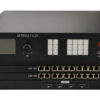
NovaStar AD20 multimedia player for LED displays up to 1.3 million pixels. Combines synchronous HDMI input and asynchronous internal playback, with HDMI cascading, two LED Gigabit outputs, switchable Wi-Fi AP/Sta and optional 4G.
10000 in stock
NovaStar AD20 LED Advertising Player
The NovaStar AD20 combines content playback and LED sending for full-color advertising displays. It supports synchronous playback from HDMI input, asynchronous playback from internal content, and multi-screen splicing through HDMI input/output cascading.
Programs and screen settings can be managed from a PC, phone or tablet. Compatible cloud publishing and monitoring platforms support remote management of displays in different locations.
Technical Specifications
| Parameter | Specification |
|---|---|
| Maximum LED load | 1.3 million pixels |
| Maximum width / height | 4096 pixels each; total load remains within 1.3 million pixels |
| LED outputs | 2 × Gigabit Ethernet; default two primary ports, configurable as one primary and one backup |
| HDMI input | 1 × HDMI 1.4 for synchronous playback |
| HDMI output | 1 × HDMI 1.4; up to 1080p at 60 Hz; HDMI Loop supported |
| Processor | Quad-core ARM Cortex-A55, 1.8 GHz |
| RAM / internal storage | 1 GB / 32 GB |
| Video playback combinations | 1 × 4K, 2 × 1080p, 4 × 720p, 4 × 480p or 6 × 360p |
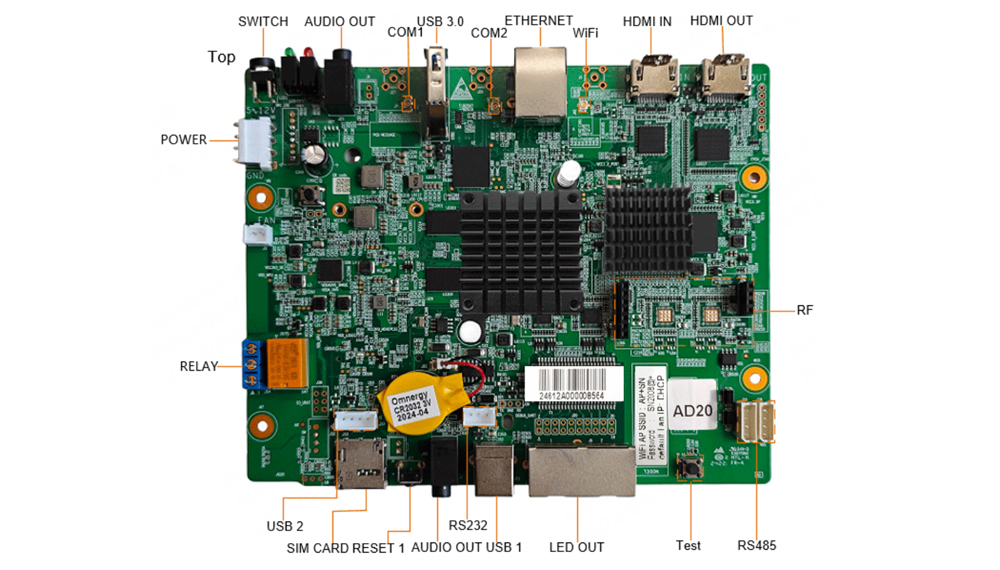
| Control interfaces | USB 3.0 Type A, USB Type B and Gigabit Ethernet |
| Sensor interfaces | 2; for brightness or temperature/humidity sensors |
| Input voltage / maximum power | DC 5 V to 12 V / 18 W |
| Operating environment | −20°C to +60°C; 0% RH to 80% RH, non-condensing |
| Storage environment | −40°C to +80°C; 0% RH to 80% RH, non-condensing |
| Dimensions / net weight | 165.0 × 139.8 × 20.3 mm / 183.8 g |
Synchronous, Asynchronous and Spliced Displays
Asynchronous mode uses the internal media source. Synchronous mode uses HDMI input. For synchronous full-screen scaling, the specification requires a video-source width from 64 to 2048 pixels and supports downscaling only, not upscaling. HDMI input/output cascading supports multi-screen splicing.
Video decoding capacity is separate from the 1.3-million-pixel LED load. The feature summary refers to H.264/H.265 4K at 60 Hz, while the detailed decoding table lists H.264 at 30 fps and H.265/HEVC at 60 fps. Use the format-specific table when preparing media; confirm any H.264 60 fps requirement before deployment.
Publishing, Wi-Fi and Optional Modules
USB Type A supports program playback and firmware upgrades. Supported USB drives use FAT32 or NTFS, range from 2 GB to 128 GB, and require individual files larger than 0 KB and smaller than 4 GB.
Wi-Fi AP and Sta are switchable modes. In AP mode, connect the user device to the AD20 hotspot. In Sta mode, connect the user device and AD20 to the same router. When several network methods are available, priority is wired Ethernet, Wi-Fi, then 4G.
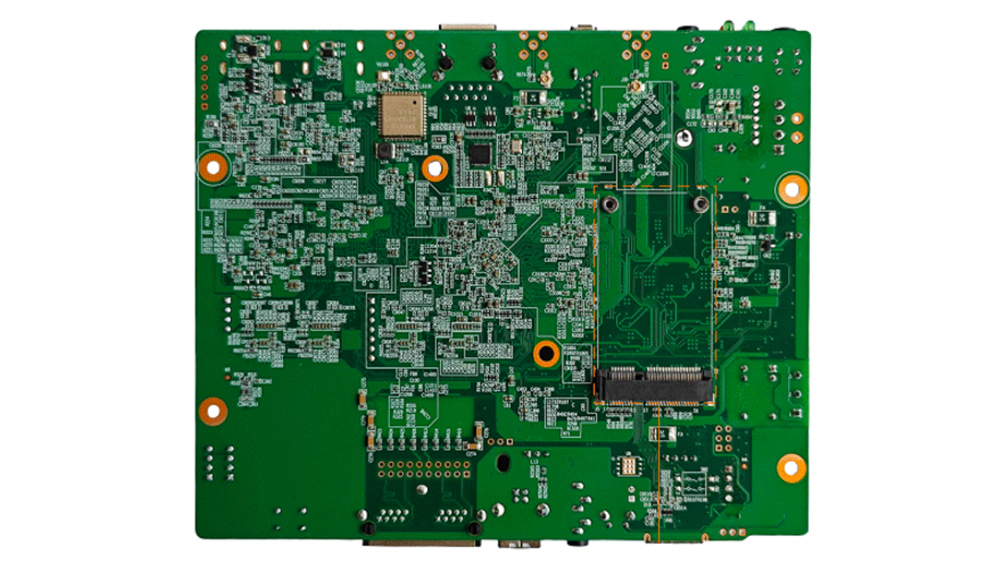
The 4G module is not included by default. Multi-screen synchronized playback supports NTP, GPS with the specified 4G module, or RF with the specified RF module. Third-party Android application installation is not supported.
Audio Connection Note
Internal audio uses 48 kHz; external audio supports 32, 44.1 and 48 kHz. Audio through a multifunction card must use 48 kHz. The PDF feature list describes one stereo output, while its connector table labels two AUDIO OUT connectors; confirm the supplied board’s audio layout if this is important to your installation.
Product Images and PDF

Download the AD20 specification (Chinese PDF)
Frequently Asked Questions
What is the difference between AD20 synchronous and asynchronous modes?
Synchronous mode displays the HDMI input source. Asynchronous mode plays the internal media source. The AD20 provides a dedicated mode-switch key.
How should I connect to AD20 over Wi-Fi?
In AP mode, connect your device to the AD20 hotspot using the details on its label. In Sta mode, the AD20 and your device should connect to the same router. The specification describes switching between these modes.
Can AD20 drive a 4096 × 4096 LED display?
No. Maximum width and height are each 4096 pixels, but total LED load is limited to 1.3 million pixels. Both dimension limits cannot be combined into a 4096 × 4096 load.
Can AD20 splice several displays through HDMI?
Yes. HDMI input and output cascading supports multi-screen splicing. HDMI output is specified up to 1080p at 60 Hz; synchronous full-screen scaling supports downscaling only for source widths from 64 to 2048 pixels.
Does AD20 include 4G connectivity as standard?
The card supports a 4G module, but the module is not included by default. GPS timing requires the specified 4G module; RF timing requires the specified RF module.
| Weight | 13 kg |
|---|
Be the first to review “NovaStar AD20 LED Multimedia Player | Sync & Async”
You must be logged in to post a review.
Will I be charged with customs and taxes?
The prices displayed on our site are tax-free (in US Dollars), which means you may be required to pay import duties and taxes once you receive your order. Import taxes, duties, and related customs fees will be determined by your local customs office when your order arrives at its final destination.
Please note that these additional charges and taxes are your responsibility, and we do not take any responsibility for them. We are not liable for paying or reimbursing any customs duties, taxes, or related fees. For more details on these charges, please contact your local customs office.
Shipping
We can ship to virtually any address in the world. Note that there are restrictions on some products, and some products cannot be shipped to international destinations..
When you place an order, we will estimate shipping and delivery dates for you based on the availability of your items and the shipping options you choose. Depending on the shipping provider you choose, shipping date estimates may appear on the shipping quotes page.
Please also note that the shipping rates for many items we sell are weight-based. The weight of any such item can be found on its detail page. To reflect the policies of the shipping companies we use, all weights will be rounded up to the next full pound..
Returns Policy
You may return most new, unopened items within 30 days of delivery for a full refund. We'll also pay the return shipping costs if the return is a result of our error (you received an incorrect or defective item, etc.)..
You should expect to receive your refund within four weeks of giving your package to the return shipper, however, in many cases you will receive a refund more quickly. This time period includes the transit time for us to receive your return from the shipper (5 to 10 business days), the time it takes us to process your return once we receive it (3 to 5 business days), and the time it takes your bank to process our refund request (5 to 10 business days).
If you need to return an item, simply login to your account, view the order using the "Complete Orders" link under the My Account menu and click the Return Item(s) button. We'll notify you via e-mail of your refund once we've received and processed the returned item..
Related products
Reviews
There are no reviews yet.