

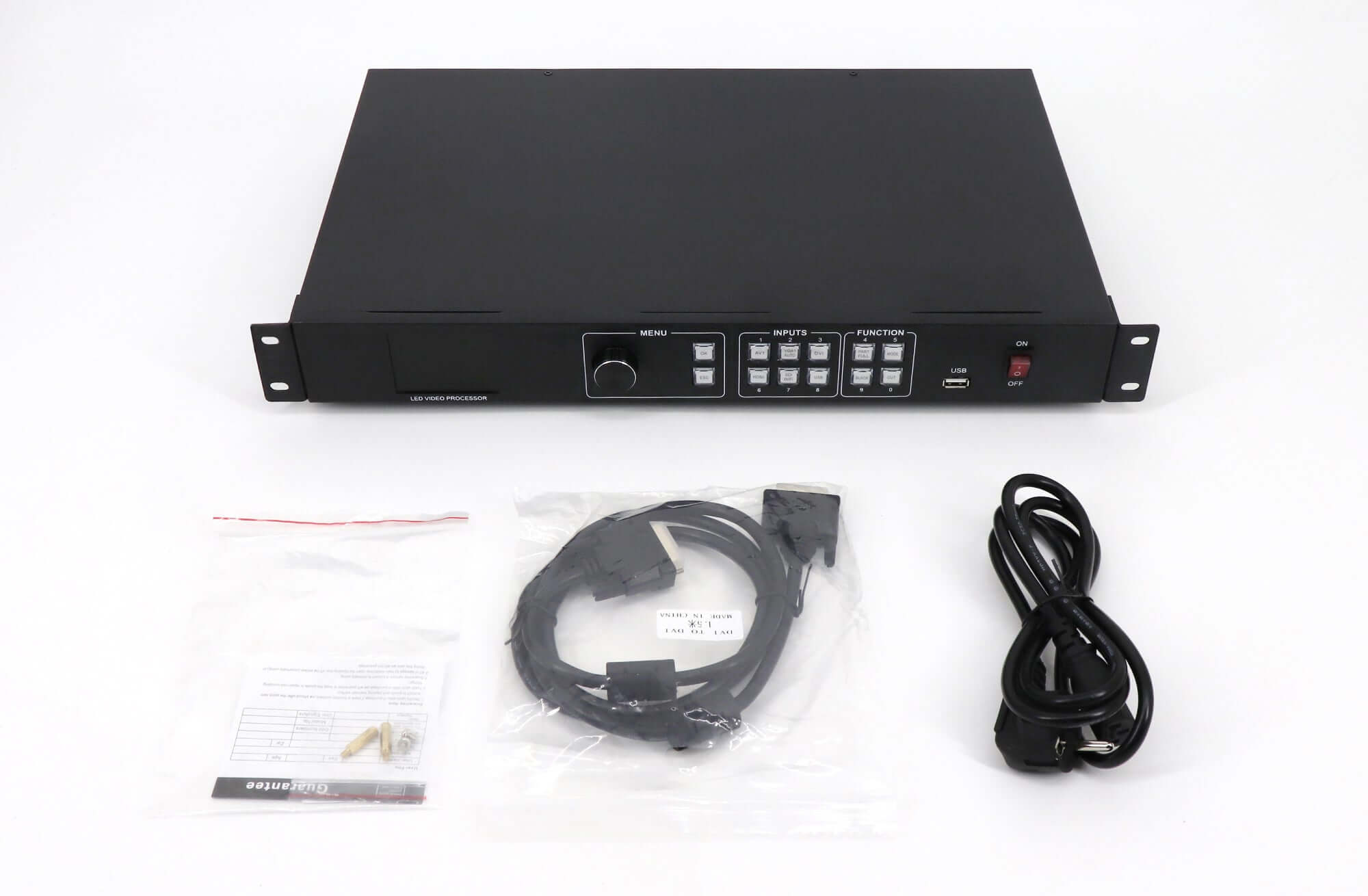


Amoonsky AMS-MVP300 LED Video Processor with Dual DVI
$ 135.00
Amoonsky AMS-MVP300 LED video processor with five listed standard source inputs, two DVI outputs and ten user presets. Wi-Fi and SDI are model-dependent options; check the required output mode and sending-card configuration.
9993 in stock
AMS-MVP300 video processing for LED display systems
The Amoonsky AMS-MVP300 handles source switching, image adjustment and DVI output to an LED sending card or compatible display. Its standard input list includes HDMI, DVI, VGA, composite AV and USB playback, with optional Wi-Fi and SDI variants.
The brochure contains conflicting channel-count and resolution wording. The table follows the detailed connector lists, keeps the documented resolution statements visible and separates scaling claims from native output capability.
Technical specifications
| Parameter | Specification |
|---|---|
| Model / standard version | Amoonsky AMS-MVP300; product number PN201970001 |
| Standard source inputs | 1 HDMI, 1 DVI, 1 VGA, 1 composite AV and 1 USB playback input |
| Optional variants | AMS-MVP300W: Wi-Fi wireless display; AMS-MVP300S: SDI option with loop connection |
| Input-count clarification | The brochure headline says six channels, but the detailed standard-input list contains five; Wi-Fi and SDI are optional |
| DVI / VGA input limit | Up to 1920 × 1080 at 60 Hz in the individual input rows |
| HDMI / composite input | HDMI: 480i/p, 576i/p, 720p, 1080i/p; AV: PAL, NTSC, PAL-M/N and SECAM |
| Video outputs | 2 DVI connectors in the detailed output table; the headline’s “3-channel” statement does not identify a third connector |
| DVI routing note | The table also mentions a DVI1 loop output; independent-output routing is not established |
| Output-resolution reference | Overview: maximum 1920 × 1080 at 60 Hz. Conversion table also lists 1024 × 768, 1280 × 720, 1280 × 1024 and 1600 × 1200 at 60 Hz; confirm the required mode. |
| Source and screen controls | Seamless source switching, signal detection, black/freeze and keypad lock |
| User presets | 10 sets; manual says to enable preset storage/recall in the system menu |
| Image processing | 24-bit scaling description, brightness adjustment, 34-level gamma and ACC/ACM filtering |
| Scaling qualification | The brochure’s 10× / 19,200-pixel statement concerns scaling; it is not a confirmed native output resolution |
| Audio / USB | 1 audio output; USB-drive playback. Supported media codecs and storage limits are not detailed. |
| Sending-card installation | Space for 2 sending cards is described; included cards and exact compatibility must be confirmed |
| Power input | 100–240 V AC, 50–60 Hz |
| Operating / storage conditions | 0 to 50°C operating; −40 to 70°C storage; 10–90% RH non-condensing |
| Chassis / rack dimensions | 440 × 320 × 68 mm excluding connectors and mounting ears; 485 × 320 × 68 mm including ears |
| Product / package weight | 3.0 kg / 4.0 kg |
Product images and specification download


Amoonsky AMS-MVP300 LED Display Video Processor Specification
Frequently asked questions
How many inputs and outputs does the standard MVP300 have?
The detailed list identifies five standard inputs: HDMI, DVI, VGA, composite AV and USB playback. It identifies two DVI outputs. Brochure headlines stating six inputs and three outputs do not match that detailed list; optional Wi-Fi and SDI depend on the supplied variant.
Are Wi-Fi and SDI standard features?
No. The document identifies AMS-MVP300W for Wi-Fi wireless display and AMS-MVP300S for the SDI option with a loop connection. Confirm the full model and installed hardware.
Can the processor output a native 19,200-pixel-wide image?
The 19,200-pixel statement appears in a 10× scaling description. The overview lists 1920 × 1080 at 60 Hz as the maximum output, while the conversion table includes additional modes such as 1600 × 1200. Confirm the actual output mode; do not treat the scaling statement as native resolution.
Does it include two LED sending cards?
The manual describes space to install two sending cards. It does not establish that cards are included or that every card is compatible, so confirm the supplied configuration and the intended receiver system.
Can I save presets and play content from a USB drive?
The processor supports ten user-preset sets, with the manual specifying that the preset function must be enabled in the system menu. USB-drive playback is listed, but the document does not give detailed codec or storage limits.
| Weight | 5.5 kg |
|---|
Be the first to review “Amoonsky AMS-MVP300 LED Video Processor with Dual DVI”
You must be logged in to post a review.
Will I be charged with customs and taxes?
The prices displayed on our site are tax-free (in US Dollars), which means you may be required to pay import duties and taxes once you receive your order. Import taxes, duties, and related customs fees will be determined by your local customs office when your order arrives at its final destination.
Please note that these additional charges and taxes are your responsibility, and we do not take any responsibility for them. We are not liable for paying or reimbursing any customs duties, taxes, or related fees. For more details on these charges, please contact your local customs office.
Shipping
We can ship to virtually any address in the world. Note that there are restrictions on some products, and some products cannot be shipped to international destinations..
When you place an order, we will estimate shipping and delivery dates for you based on the availability of your items and the shipping options you choose. Depending on the shipping provider you choose, shipping date estimates may appear on the shipping quotes page.
Please also note that the shipping rates for many items we sell are weight-based. The weight of any such item can be found on its detail page. To reflect the policies of the shipping companies we use, all weights will be rounded up to the next full pound..
Returns Policy
You may return most new, unopened items within 30 days of delivery for a full refund. We'll also pay the return shipping costs if the return is a result of our error (you received an incorrect or defective item, etc.)..
You should expect to receive your refund within four weeks of giving your package to the return shipper, however, in many cases you will receive a refund more quickly. This time period includes the transit time for us to receive your return from the shipper (5 to 10 business days), the time it takes us to process your return once we receive it (3 to 5 business days), and the time it takes your bank to process our refund request (5 to 10 business days).
If you need to return an item, simply login to your account, view the order using the "Complete Orders" link under the My Account menu and click the Return Item(s) button. We'll notify you via e-mail of your refund once we've received and processed the returned item..
Related products


Reviews
There are no reviews yet.