


NovaStar KU20 COEX LED Controller | 6 Ethernet Outputs
$ 735.00
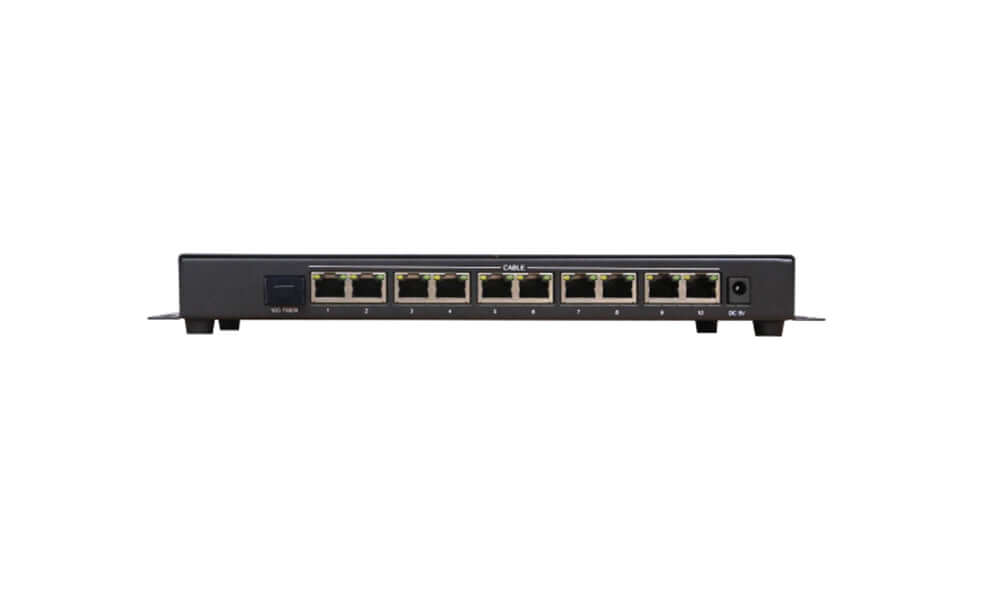
The NovaStar KU20 is a COEX LED display controller with one HDMI 1.3 input and loop output, six Gigabit Ethernet outputs and one 10G optical output. It supports up to 3.9 million pixels and works with VMP. The linked V1.1.0 specification documents standard 8-bit output; 10-bit output requires customization and an A10s Pro receiving card.
10000 in stock
NovaStar KU20 COEX LED Display Controller
The KU20 takes an HDMI video source and sends it to an LED display through six Ethernet outputs or its 10G optical connection. Part of NovaStar’s COEX control system, it works with VMP (Vision Management Platform) for configuration, device management and monitoring.
All-In-One Controller mode provides layer and scaling functions. Send-Only Controller mode provides the alternative operating mode. Image scaling can be custom or pixel to pixel. The parameters below are from the original linked KU20 Specifications V1.1.0, dated April 28, 2023.
| Parameter | Specification |
|---|---|
| Input / loop | 1 × HDMI 1.3 input with HDMI loop output; up to 8 devices in one HDMI loop |
| Input resolution | Maximum listed resolution 1920 × 1200 at 60 Hz; minimum 800 × 600 at 60 Hz; custom examples 3840 × 600 and 800 × 2560 at 60 Hz |
| Input formats | 8-bit/10-bit RGB 4:4:4, YCbCr 4:4:4 or YCbCr 4:2:2; HDCP 1.4; interlaced input not supported |
| LED outputs | 6 × Gigabit Ethernet; maximum device capacity 3.9 million pixels; hot backup between Ethernet ports |
| Per-port capacity | 659,722 pixels at 8-bit/60 Hz; 329,861 pixels at 8-bit/120 Hz. Capacity depends on frame rate |
| Optical output | 1 × 10G optical output |
| Output bit depth | Standard 8-bit in V1.1.0; 10-bit requires a customized KU20 program with A10s Pro receiving cards |
| Control connections | 2 × Gigabit Ethernet control ports for VMP; up to 20 KU20 devices in a control cascade |
| USB port | USB 2.0 for exporting diagnostic results and sending cabinet configuration files; NTFS/FAT32 |
| Latency | Low-latency controller processing: 0 frames, less than 1 ms, with layout conditions; additional delay adjustable from 0 to 2 frames |
| Power | 100–240 V AC, 50/60 Hz, 1.5 A; maximum consumption 25 W |
| Operating environment | −20°C to +50°C; 0–80% RH, non-condensing |
| Dimensions / net weight | 254.3 × 50.6 × 290.0 mm; 2.1 kg |
| Protection / reserved ports | IP20; SPDIF audio output and AUX RS232 are reserved in this revision |
Screen Layout, Calibration and Compatibility
For irregular screens, unused blank areas do not count toward Ethernet loading; the cabinet pixel totals determine the load. This does not remove the device, per-port or input-resolution limits.
Full Grayscale Calibration requires A10s Pro receiving cards and the NovaStar calibration system with the C3200 camera. Frame Rate Adaptive also requires A10s Pro cards, a Cabinet Tool-generated .ncp file and a supported driver IC. V1.1.0 lists ICND2055, ICND2065, MBI5253A, MBI5253B, MBI5754B, MBI5264 and CFD555. Fine frame-rate adjustment is specified in 0.01 Hz steps.
To enable low latency, all Ethernet ports must load cabinets vertically and share the same Y coordinate. The less-than-1 ms figure applies to the controller, not the complete source-to-display system. Pixel-level brightness and chroma calibration uses NovaStar’s calibration system. SNMP and Art-Net are supported for integration.
Frequently Asked Questions
What is the NovaStar KU20 maximum pixel capacity?
V1.1.0 specifies up to 3.9 million pixels for the device and 659,722 pixels per Ethernet port at 8-bit/60 Hz. Per-port capacity changes with frame rate, and input resolution and cabinet mapping must also fit the configuration.
Does KU20 support 10-bit output?
It accepts 8-bit and 10-bit video input. Standard output is 8-bit in the linked V1.1.0 specification. 10-bit output requires a customized KU20 program and A10s Pro receiving cards.
Which software controls the KU20?
The KU20 works with NovaStar VMP, or Vision Management Platform, through its Ethernet control ports. Its USB port is documented for diagnostics and cabinet configuration files, not USB video playback.
Can KU20 scale the image?
Yes. In All-In-One Controller mode it provides layer and scaling functions, with custom and pixel-to-pixel scaling modes. Send-Only Controller is the other documented working mode.
How do I achieve KU20 low latency?
The linked specification requires each Ethernet port to load cabinets vertically and all ports to share the same Y coordinate. The documented controller latency is zero frames, less than 1 ms, without reducing load capacity; other system components contribute their own delay.
Downloads
| Weight | 3.5 kg |
|---|
Be the first to review “NovaStar KU20 COEX LED Controller | 6 Ethernet Outputs”
You must be logged in to post a review.
Will I be charged with customs and taxes?
The prices displayed on our site are tax-free (in US Dollars), which means you may be required to pay import duties and taxes once you receive your order. Import taxes, duties, and related customs fees will be determined by your local customs office when your order arrives at its final destination.
Please note that these additional charges and taxes are your responsibility, and we do not take any responsibility for them. We are not liable for paying or reimbursing any customs duties, taxes, or related fees. For more details on these charges, please contact your local customs office.
Shipping
We can ship to virtually any address in the world. Note that there are restrictions on some products, and some products cannot be shipped to international destinations..
When you place an order, we will estimate shipping and delivery dates for you based on the availability of your items and the shipping options you choose. Depending on the shipping provider you choose, shipping date estimates may appear on the shipping quotes page.
Please also note that the shipping rates for many items we sell are weight-based. The weight of any such item can be found on its detail page. To reflect the policies of the shipping companies we use, all weights will be rounded up to the next full pound..
Returns Policy
You may return most new, unopened items within 30 days of delivery for a full refund. We'll also pay the return shipping costs if the return is a result of our error (you received an incorrect or defective item, etc.)..
You should expect to receive your refund within four weeks of giving your package to the return shipper, however, in many cases you will receive a refund more quickly. This time period includes the transit time for us to receive your return from the shipper (5 to 10 business days), the time it takes us to process your return once we receive it (3 to 5 business days), and the time it takes your bank to process our refund request (5 to 10 business days).
If you need to return an item, simply login to your account, view the order using the "Complete Orders" link under the My Account menu and click the Return Item(s) button. We'll notify you via e-mail of your refund once we've received and processed the returned item..
Related products


Reviews
There are no reviews yet.